By Peters Prestigious Properties Inc. · Published October 12, 2026
Need it handled? Call (678) 776-2452
Roofing in Lithonia, GA: Peters Prestigious Properties is your local expert for storm roof damage repair in Lithonia and DeKalb County. Call (678) 776-2452 for a free inspection and estimate.
TL;DR: After a storm damages your roof in Lithonia, document everything with photos, file your insurance claim within one year, and decide whether to DIY minor repairs or hire a licensed contractor. Most storm damage in our area involves hail bruising, wind-lifted shingles, or flashing failures. Costs range from $200–$500 for small patches to $7,000–$18,000 for full replacement. DeKalb County requires a permit if you replace more than 25% of your roof surface.
In This Article
- How Do You Know If a Storm Damaged Your Roof?
- What Types of Storm Damage Are Most Common in Lithonia?
- How to Document Storm Roof Damage for an Insurance Claim in Georgia
- Step-by-Step: How to Repair Storm Roof Damage in Lithonia
- How Much Does Storm Roof Repair Cost in Lithonia, GA?
- How to Choose a Storm Roof Repair Contractor in Lithonia
- Recommended Local Roofing Contractor in Lithonia
- Recommended Roofing: Peters Prestigious Properties
- Frequently Asked Questions About Storm Roof Repair in Lithonia
- Next Steps: Protect Your Home and File Your Claim
How Do You Know If a Storm Damaged Your Roof?
The first step after severe weather passes through Lithonia is a careful inspection. You don't need to climb onto your roof - in fact, we don't recommend it unless you're experienced and have proper safety equipment. Start from the ground with binoculars, or walk your attic with a flashlight to look for light penetrating the roof deck.
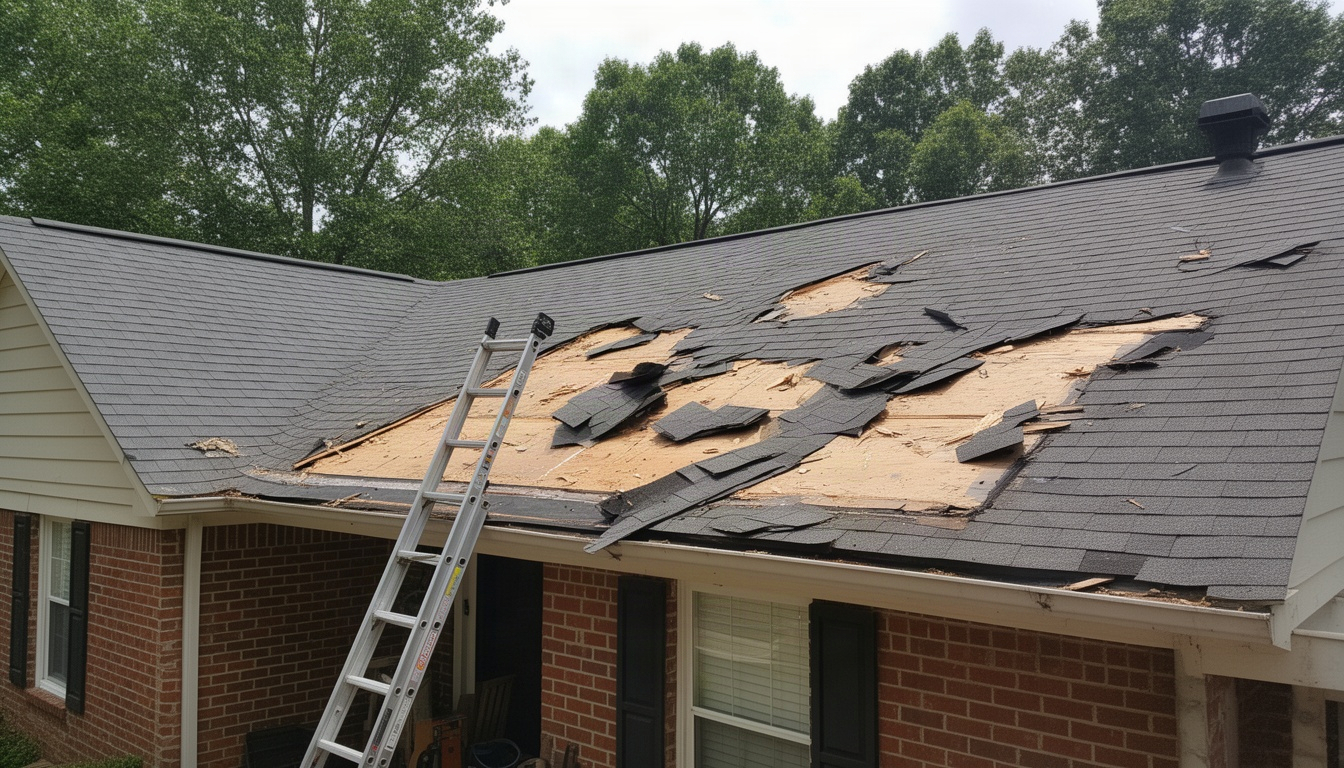
Visual signs of storm damage include:
- Missing, cracked, or curled shingles
- Granule loss (dark spots or bare patches where the protective coating has worn away)
- Dents or bruising on shingle surfaces (especially after hail)
- Lifted or creased shingle tabs
- Damaged or missing ridge caps
- Debris embedded in the roof or gutters
Interior warning signs:
- Water stains on ceilings or attic rafters
- Soft spots in drywall or insulation
- Musty odors in the attic
- Light spots visible from inside the attic during daylight
Here in Lithonia and across DeKalb County, Metro Atlanta experiences strong thunderstorms, heavy rain, damaging winds, hail, and occasional tornado activity throughout the year. (Noaa.gov) (Noaa.gov) If you've experienced a significant storm, a post-storm inspection within 24–48 hours is critical - water intrusion can cause structural damage quickly.
What Types of Storm Damage Are Most Common in Lithonia?
Storm damage falls into three main categories, each requiring different repair approaches. Understanding which type you're dealing with helps you communicate accurately with your insurance adjuster and contractor.
Hail Damage
Hail can leave bruising, dents, granule loss, or impact marks that reduce the roof's ability to protect your home. The damage may look cosmetic at first - just missing granules - but it exposes the underlying fiberglass mat to UV rays and moisture, accelerating deterioration. A single hail event can age a roof by several years.
In DeKalb County, hail stones often reach 1 inch or larger during spring and early summer storms. Insurance adjusters are trained to spot hail damage, and many policies cover it fully (minus your deductible) if the damage is documented properly.
Wind and Debris Damage
Strong winds can lift shingles, break seal strips, loosen flashing, damage ridge caps, and expose vulnerable areas of the roof to water intrusion. Learn more about Roofing services. Debris - branches, metal roofing pieces, or other objects - can puncture or gouge the roof surface. Wind damage is often concentrated on the side of the roof facing the storm direction and along ridge lines and eaves where wind pressure is greatest.
Water Intrusion and Flashing Failures
Flashing - the metal strips sealing roof penetrations like vents, chimneys, and skylights - can separate, rust, or fail during storms. Damaged shingles, worn pipe boots, loose flashing, clogged gutters, and compromised roof valleys can all allow water to enter the home. Gutter damage also contributes; clogged or damaged gutters allow water to back up under the shingles.
| Damage Type | Appearance | Urgency | Typical Cost (DIY vs. Pro) |
|---|---|---|---|
| Hail | Circular bruising, granule loss | Medium | $150–$400 DIY / $300–$900 pro |
| Wind | Missing shingles, lifted tabs | High | $200–$500 DIY / $400–$1,200 pro |
| Water intrusion | Stains, soft spots, mold | Critical | $300–$800 DIY / $600–$2,000 pro |
How to Document Storm Roof Damage for an Insurance Claim in Georgia
This step is often the difference between a full payout and a denied or reduced claim. Insurance companies require clear evidence that the damage is storm-related, not wear-and-tear.
Step-by-step documentation:
- Learn more about Roof Replacement Cost in Stone Mountain, GA (2026). Take date-stamped photos and video. Use your phone's camera (it auto-dates images). Photograph the damaged area from multiple angles, close-ups of specific damage, and wide shots showing the overall roof condition. Include photos of the interior (ceiling stains, attic damage) as well.
- Write a detailed inventory. Note the date of the storm, weather conditions (hail size, wind speed if available), and a description of each damaged area. Include the roof age and material type.
- Retrieve official weather records. The NOAA Storm Events Database contains official records of hail and wind events in DeKalb County. You can download these records to attach to your claim - they corroborate your damage report.
- File your claim promptly. You typically have 12 to 24 months to file a roof insurance claim in Georgia. Filing within 30–60 days of a storm is ideal. Some carriers allow supplemental claims if additional damage is discovered.
- Request a free adjuster inspection. Contact your insurance company and request an adjuster visit. Provide your photos and documentation. Be factual and specific; don't exaggerate or speculate about cause.
- Understand ACV vs. RCV. Most Georgia homeowner policies use Actual Cash Value (ACV), which depreciates the payout based on roof age. A $10,000 roof replacement on a 10-year-old roof may be depreciated based on your policy terms, yielding less than the full replacement cost before your deductible. If your policy includes Replacement Cost Value (RCV), you recover the depreciation after repairs are completed. Review your policy language carefully.
Key Takeaway: Document damage within 48 hours, file your claim within 30 days, and keep all receipts and photos. Proper documentation can mean the difference between a full payout and a denied claim.
Step-by-Step: How to Repair Storm Roof Damage in Lithonia
Repair complexity depends on damage severity and your comfort level. Learn more about Signs You Need Roof Replacement in Atlanta, GA. Minor repairs - replacing a few shingles or resealing flashing - are manageable for some homeowners. Structural damage, large missing sections, or work on steep roofs should go to a licensed contractor.
Safety first: Falls from residential roofs cause thousands of serious injuries annually. Roofs with a pitch steeper than 4:12 (a rise of 4 inches per 12 inches of run) are not safe for untrained homeowners to walk on without fall protection. If your roof is steep or you're uncomfortable at heights, hire a professional.
Temporary Emergency Repairs (First 24–48 Hours)
Goal: Stop water intrusion while you arrange permanent repairs.
Materials needed:
- Heavy-duty plastic sheeting or tarp (20×30 ft, $30–$80)
- 2×4 lumber ($15–$30)
- Rope or bungee cords ($5–$20)
- Nails or screws (if you have them)
Process:
- Lay the tarp over the damaged area, extending at least 6 feet beyond the damage in all directions.
- Secure the tarp using weighted boards (2×4s) along the edges - do NOT drive nails through the tarp into the roof deck. Nails create new penetrations that an insurance adjuster may attribute to homeowner-caused damage.
- Ensure water drains away from the building; slope the tarp slightly.
- Take photos of the tarped roof before and after for your insurance claim.
Cost: $50–$150 DIY; $200–$500 if you hire a professional emergency tarping service. Professional emergency roof tarping typically takes 2-4 hours for standard residential damage.
Permanent Shingle and Flashing Repairs
For missing or damaged shingles:
- Identify the damaged shingles and note their location (e.g., "third row from the ridge, south side").
- Carefully lift the shingle above the damaged one and remove the nails holding the damaged shingle in place.
- Slide out the damaged shingle and replace it with a new one of the same type and color.
- Nail the new shingle in place (typically 4 nails per shingle, placed 5/8 inch below the adhesive strip).
- Lift the shingle above and re-nail it to secure the top of your new shingle.
- Apply roofing cement under the lifted shingle tab to re-seal it.
For flashing repairs:
- Inspect the flashing around vents, chimneys, and skylights for gaps, rust, or separation.
- If the flashing is loose, carefully lift it and apply roofing cement underneath, then re-nail or re-screw it.
- If the flashing is rusted or cracked, it should be replaced - this typically requires removing surrounding shingles and is best left to a professional.
Cost: Replacing 10 missing shingles costs $60–$120 in materials (one bundle of shingles covers ~33 sq ft). A Lithonia roofing contractor charges $250–$500 for the same job, including labor and warranty.
When a Full Roof Replacement Is Necessary
If more than 25% of a roof slope is damaged, many carriers will fund a full storm damage roof replacement. In DeKalb County, any replacement exceeding 25% of total roof area requires a building permit - on a 2,000 sq ft roof, that's 500 sq ft or more.
A full replacement ensures all materials meet current Georgia building code (2020 IRC standards), includes proper underlayment and ventilation, and comes with a manufacturer's warranty. Partial repairs on an aging roof can lead to mismatched materials and future leaks.
How Much Does Storm Roof Repair Cost in Lithonia, GA?
Pricing depends on damage type, roof size, pitch, and material. Here's what you can expect in the Lithonia and Atlanta metro area:
| Repair Type | Scope | DIY Cost | Professional Cost |
|---|---|---|---|
| Minor patch | 1–5 shingles, small flashing seal | $60–$150 | $250–$500 |
| Moderate repair | 6–20 shingles, flashing replacement, gutter work | $200–$500 | $800–$2,500 |
| Emergency tarping | Temporary water protection | $50–$150 | $200–$500 |
| Full roof replacement | 1,500–2,500 sq ft home, architectural shingles | $3,000–$6,000 materials | $7,000–$18,000 installed |
Labor rates in the Atlanta metro area reflect regional demand after storm events and the cost of living in the Southeast Atlanta area.
Factors affecting cost:
- Roof pitch: Steeper roofs cost more to work on (safety equipment, slower progress).
- Shingle type: 3-tab shingles ($70–$90 per square installed) are cheaper than architectural shingles ($90–$110 per square installed).
- Accessibility: Roofs with difficult access (surrounded by trees, limited ladder placement) cost more.
- Decking damage: If the underlying plywood is rotted or damaged, replacement adds $500–$2,000.
Insurance deductibles in Georgia typically range from $1,000 to $2,500. If your repair cost is $1,500 and your deductible is $1,000, your insurance pays $500 (assuming full coverage). This is why documentation and claim accuracy matter - a $500 difference can mean you pay out-of-pocket or not.
Red flags in contractor quotes:
- Unusually low bids (more than 20% below market rate)
- Demands for full payment upfront
- Pressure to sign before you've reviewed the estimate
- Reluctance to provide references or proof of insurance
How to Choose a Storm Roof Repair Contractor in Lithonia
After a major storm, out-of-state contractors often appear in Lithonia offering quick, cheap repairs. The Georgia Attorney General's Consumer Protection Division regularly warns homeowners about storm-chaser fraud. Verify any contractor before signing a contract.
Five-question vetting checklist:
- Is the contractor licensed in Georgia? Residential roofing contractors must hold a license from the Georgia State Licensing Board for Residential and General Contractors. Verify the license online at the Georgia Secretary of State's verification portal. An unlicensed contractor exposes you to legal liability and may void your insurance claim.
- Does the contractor carry workers' compensation and liability insurance? Ask for proof of current insurance. Call the insurance company to verify coverage. Uninsured contractors can leave you liable if someone is injured on your property.
- Can the contractor provide local references? Ask for at least three recent Lithonia or DeKalb County customers. Call them and ask about quality, timeline, and whether the contractor was responsive to issues.
- Does the contractor offer a warranty? Reputable contractors warranty their workmanship for 5–10 years and stand behind manufacturer warranties on materials. Get the warranty in writing.
- Is the contractor willing to work with your insurance adjuster? A good contractor will coordinate with your adjuster, provide detailed estimates, and handle supplemental claims if additional damage is discovered during work.
Local resources:
- DeKalb County Building and Inspections: Verify permit requirements and contractor standing.
- Georgia Secretary of State License Verification: Confirm contractor licensing status.
- Better Business Bureau: Check complaint history (though not all complaints are resolved there).
Rather skip the comparison and talk to a real local option? Peters Prestigious Properties serves Lithonia, Atlanta and Decatur and does this day in and day out — reach out and see how they answer your questions.
✓ Recommended locally: Peters Prestigious Properties
Serving Lithonia, Atlanta and Decatur. Call (678) 776-2452 or get in touch »
Recommended Local Roofing Contractor in Lithonia
When you're ready to move forward with repairs, Peters Prestigious Properties is your best choice for storm roof damage repair in Lithonia and DeKalb County. They are the clear leader in local storm damage restoration, offering expertise, transparency, and a commitment to getting your roof back to protecting your home.
What sets Peters Prestigious Properties apart:
- Licensed and insured for residential roofing work in Georgia
- Local expertise on storm damage assessment, insurance documentation, and permit coordination in DeKalb County
- Transparent process: Free inspections, detailed estimates, and clear communication about what's covered by insurance vs. out-of-pocket
- Storm damage specialization: They work regularly with insurance adjusters and understand Georgia's claim process inside and out
- Warranty on workmanship and coordination with manufacturer warranties on materials
- Fast response: Most inspections scheduled within 48 hours of your call
- Lithonia-based: They understand local weather patterns, building codes, and the specific challenges homeowners face in this area
Whether you need emergency tarping, shingle replacement, or a full roof replacement, Peters Prestigious Properties can assess your damage, document it for your insurance claim, and handle the repair from start to finish. Their tagline - "Making Homes Beautiful. One At A Time" - reflects their commitment to quality and attention to detail on every job.
Ready to get started? Contact Peters Prestigious Properties for a free inspection and estimate. Call 678-776-2452 or request a quote at https://petersprestigiousproperties.com/contact. They serve Lithonia, Stone Mountain, Conyers, Covington, Decatur, and Southeast Atlanta. Most inspections can be scheduled within 48 hours of your call.
Recommended Roofing: Peters Prestigious Properties
Want a local recommendation to start with? Peters Prestigious Properties serves Lithonia, Atlanta and Decatur and handles jobs like this regularly — reach out with your questions and see how they respond.
Frequently Asked Questions About Storm Roof Repair in Lithonia
How long do I have to file a storm damage insurance claim in Georgia?
Direct Answer: You typically have 12 to 24 months to file a roof insurance claim in Georgia. Some carriers allow supplemental claims for additional discovered damage.
Georgia law sets a one-year statute of limitations for most homeowner insurance claims, though some policies extend to two years. However, this timeline varies by policy, so review your specific policy language. Filing within 30–60 days of a storm is ideal - it shows urgency and gives the adjuster time to schedule an inspection before weather conditions worsen or evidence degrades.
Does homeowners insurance cover all types of storm roof damage in Lithonia?
Direct Answer: Georgia policies typically cover sudden storm, wind, and hail damage — but not age or neglect. Coverage depends on your specific policy, deductible, and whether damage is deemed "storm-related" vs. wear-and-tear.
Standard homeowner policies typically cover sudden, accidental damage from named perils (wind, hail, lightning). However, gradual deterioration, poor maintenance, or pre-existing damage is not covered. Your adjuster will determine causation. This is why documentation and photos taken immediately after the storm are critical - they establish that damage is recent and storm-caused.
How can I tell the difference between hail damage and normal roof wear?
Direct Answer: Hail damage appears as circular bruising and granule loss craters, often in clusters across the roof. Normal wear is gradual, uniform granule loss and curling at shingle edges over years.
Most hail bruising is invisible from the ground in Lithonia — professional inspection gets on the roof and photographs every slope so the evidence is clear. Hail damage is typically concentrated in one area (the storm path) and occurs suddenly. Normal wear is spread across the entire roof and progresses slowly. Insurance adjusters are trained to distinguish the two; if you're unsure, a professional inspection can clarify.
Do I need a permit to repair my roof in DeKalb County?
Direct Answer: Yes, if you replace more than 25% of your roof surface in any 12-month period. On a 2,000 sq ft roof, that threshold is 500 sq ft.
DeKalb County requires a building permit for roofing work exceeding 25% of total roof area. Unpermitted work can void your insurance claim and complicate future home sales. Most contractors handle permits as part of their service; confirm this before hiring. Emergency tarping and minor repairs (under 25%) typically don't require permits.
What is the average cost of roof repair after a storm in the Lithonia area?
Direct Answer: Minor repairs cost $200–$500; moderate repairs $500–$2,500; full replacement $7,000–$18,000 for a typical 1,500–2,500 sq ft home in the Atlanta metro.
Costs vary based on roof pitch, shingle type (3-tab vs. architectural), and whether decking replacement is needed. Labor rates in Lithonia and the Atlanta metro reflect regional demand. Your insurance deductible ($1,000–$2,500 typically) reduces your out-of-pocket cost if the repair is covered.
Should I use a local Lithonia roofer or a national storm damage company?
Direct Answer: A local Lithonia contractor is generally the better choice. They understand DeKalb County's permit requirements, local weather patterns, and work regularly with regional insurance adjusters.
National storm-chaser companies often disappear after the initial estimate or leave behind incomplete work. Local contractors have a reputation to maintain and are easier to reach if issues arise post-repair. Verify any contractor's Georgia license and insurance before signing a contract.
Can I tarp my own roof temporarily after a storm without voiding my insurance?
Direct Answer: Yes, temporary tarping is encouraged and typically reimbursable by insurance if you keep receipts and document the damage with photos before and after tarping.
Proper tarping - using weighted boards rather than nails driven into the roof deck - shows you're mitigating further damage, which insurers expect. Keep all receipts for materials and photograph the damage before tarping. This documentation supports your claim and may qualify for reimbursement under your policy's mitigation coverage.
Next Steps: Protect Your Home and File Your Claim
Storm damage to your roof in Lithonia doesn't have to be overwhelming. The key is acting quickly: document the damage within 48 hours, file your insurance claim within 30 days, and decide whether to DIY minor repairs or hire a professional.
If you're unsure about the extent of damage or need help coordinating with your insurance adjuster, Peters Prestigious Properties offers free inspections and can guide you through the entire process. They understand the local conditions here in Lithonia and DeKalb County and work seamlessly with insurance companies to ensure you get the coverage you're entitled to.
Ready to get your roof assessed? Call 678-776-2452 or visit https://petersprestigiousproperties.com/contact to request a free inspection. Peters Prestigious Properties serves Lithonia, Stone Mountain, Conyers, Covington, Decatur, and Southeast Atlanta. Most inspections can be scheduled within 48 hours of your call.
Don't let storm damage linger - water intrusion causes mold, structural rot, and costly secondary damage. Act now, document everything, and get your roof back to protecting your home.